
Water Resources and Hydrology Group
SOFTWARE
PyLandslide is a machine learning-assisted open-source Python tool for landslide susceptibility mapping and uncertainty analysis.
For details on how to install and use the tool, please refer to the Documentation.
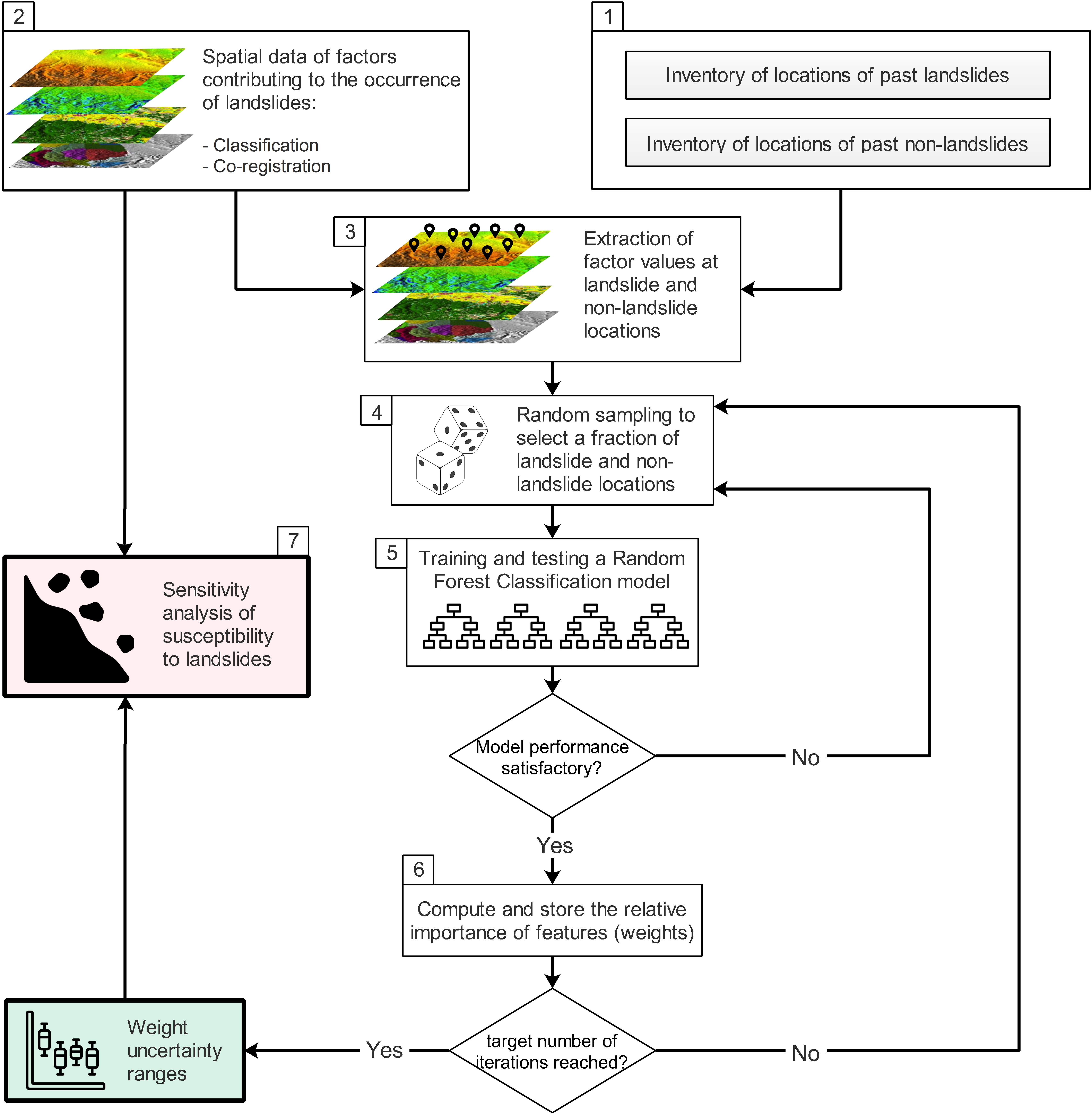
PyLandslide is a tool for spatial mapping of landslide susceptibility. The tool uses “qualitative map combination,” in which the effects of multiple factors that contribute to landslide occurrence are combined using weights. The tool uses Machine learning to determine weights and their uncertainties. The tool is also designed to conduct sensitivity analysis based on weight ranges and spatially compare the outcomes of different weight choices.
Landslide susceptibility and uncertainty analysis can be performed in PyLandslide either through high-level commands or using Python code. Either way, some inputs to different methods and functionalities need to be provided through JSON-based document format. The Documentation page provides further details on how to use the tool and provides the required inputs.
PyLandslide works on Python 3.6 (or later) on Windows, Linux, or OS X.
See the documentation for details on how to install PyLandslide.
PyLandslide can be installed by running:
pip install PyLandslideFor advanced users, developers, and those who wish to contribute to the development of PyLandslide, make sure to have installed the required dependencies. Then clone the repository:
git clone https://github.com/WRHGroup/PyLandslide.gitOnce the repository is cloned, navigate to its directory and run:
python setup.py installOr the following for development mode:
python setup.py developPlease cite the following paper when using PyLandslide:
Basheer, M., Oommen, T., 2024. PyLandslide: A Python tool for landslide susceptibility mapping and uncertainty analysis. Environmental Modelling and Software. 106055. https://doi.org/10.1016/j.envsoft.2024.106055.
Copyright (C) 2023, Mohammed Basheer and Thomas Oommen.
PyLandslide is released under the GNU General Public License.
You can use GAMS models with multiobjective evolutionary algorithms to tackle complex problems in various domains. Check out the blog article below.

The Nile Basin Streamflow Explorer is an open-source, browser-based tool for exploring projections of naturalized streamflow across the Nile Basin under climate change. The tool accompanies an openly available dataset of naturalized streamflow projections for the sub-basins and individual river reaches of the Nile Basin. The projections cover 1983–2098 under three climate scenarios: SSP1-2.6, SSP2-4.5, and SSP5-8.5. Users can select any sub-basin or reach from an interactive map or a dropdown list and view its streamflow as daily values, annual means, or moving averages with an adjustable window. For each scenario, the tool can show the individual projections, the ensemble median, and the 10th–90th percentile band, which allows the three SSPs to be compared directly. Results can be exported as CSV files. Flows are reported in million m³ day⁻¹. All computations run locally in the user’s web browser, so the flow data never leaves the user’s computer, and no installation is required.
Open the tool: https://wrhgroup.github.io/NileFlowAPI/
Introduction
Optienv is a lightweight, open-source Python framework for multi-objective optimization of external simulation models. Optienv links evolutionary algorithms to existing simulators without changes to the simulator’s code. The user writes a short Python wrapper that reads candidate decision variable values from a CSV file, runs the model, and writes the resulting objective values back to a CSV file. Optienv then searches for Pareto-optimal solutions using NSGA-II or NSGA-III. NSGA-III uses reference directions to maintain a well-spread set of solutions in many-objective problems (four or more objectives). Model evaluations can run in parallel on multiple processors, and long runs can be checkpointed and resumed. Optimization runs are controlled through high-level commands, with model and algorithm settings provided in a JSON configuration file. After a run, Optienv can extract the global Pareto front across multiple random seeds and compute normalized hypervolume to track convergence. The Documentation includes tutorials, among them an example of calibrating a Wflow hydrological model.
Installation
Optienv works on Python 3.10 (or later) on Windows, Linux, or macOS.
Optienv can be installed by running: pip install optienv
For advanced users, developers, and those who wish to contribute to the development of Optienv, clone the repository:
git clone https://github.com/WRHGroup/optienv.git
Once the repository is cloned, navigate to its directory and run:
pip install -e .
